
Whipple Surgery in Patna
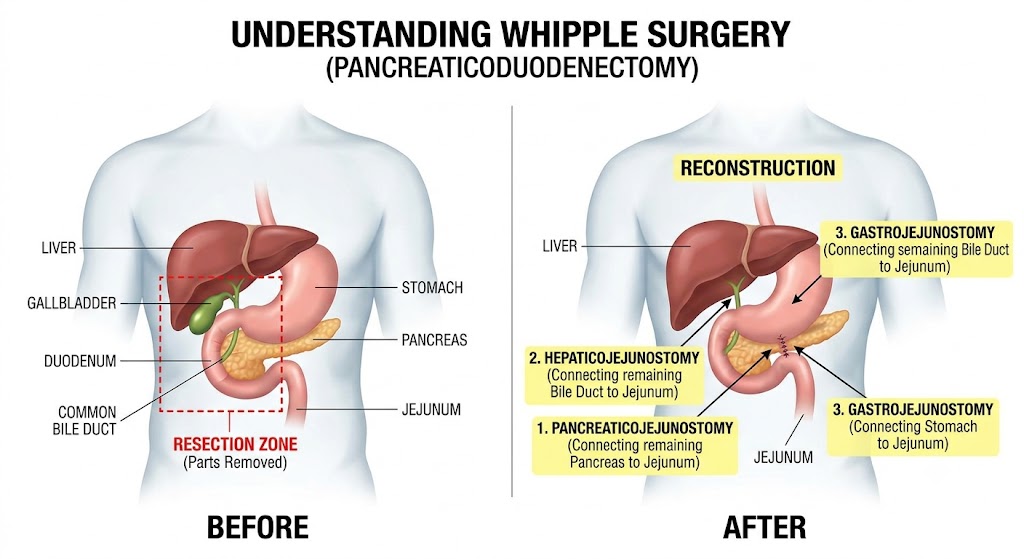
Whipple surgery, or pancreaticoduodenectomy, is the primary curative surgical treatment for tumors and cancers located in the head of the pancreas and the surrounding periampullary region.
Pancreatic and periampullary tumors require early diagnosis, precise staging, and specialized surgical execution. Due to the intricate relationship between the pancreas, bile ducts, duodenum, and major blood vessels in the upper abdomen, Whipple surgery demands meticulous surgical oncology expertise and advanced post-operative care.
What is Whipple Surgery?
Whipple surgery (pancreaticoduodenectomy) is a major, highly specialized operation designed to remove tumors located in the head (the wide part) of the pancreas. Because of shared blood supply and direct anatomical connections, the procedure entails the removal of the affected portion of the pancreas along with adjacent digestive structures, followed by comprehensive digestive tract reconstruction.
Organs and Structures Addressed During the Procedure
Head of the pancreas: The primary site of the tumor.
Duodenum: The initial C-shaped portion of the small intestine.
Gallbladder & common bile duct: Cleared to ensure proper margin clearance and prevent obstruction.
Lower portion of the stomach: (Removed in a classic Whipple; preserved in a pylorus-preserving procedure when oncologically appropriate).
Regional lymph nodes: Thorough lymphadenectomy performed for accurate oncological clearance and staging.
Conditions Treated with Whipple Surgery
Whipple surgery is performed for both malignant (cancerous) and benign or pre-cancerous conditions:
Malignant Tumors (Cancers):
Pancreatic head cancer (adenocarcinoma)
Ampullary cancer (cancer of the ampulla of Vater)
Distal common bile duct cancer (cholangiocarcinoma)
Duodenal cancer
Pancreatic neuroendocrine tumors (pNETs)
Pre-cancerous & Benign Conditions:
Intraductal Papillary Mucinous Neoplasms (IPMN)
Mucinous cystic neoplasms
Chronic pancreatitis localized to the head of the pancreas causing severe intractable pain or obstruction
How is Whipple Surgery Performed?
The surgery is conducted in two primary phases:
Phase 1: Resection (Removal)
Through an abdominal incision, a careful exploration is performed to confirm resectability and rule out distant spread. The surgeon then delicately mobilizes the head of the pancreas off major blood vessels (such as the portal vein and superior mesenteric vessels), removing the tumor along with the duodenum, lower bile duct, gallbladder, and draining lymph nodes.
Phase 2: Reconstruction (Digestive Reconnection)
Following resection, the digestive tract must be re-established to restore the flow of food, bile, and pancreatic enzymes. Three primary connections (anastomoses) are fashioned:
Pancreaticojejunostomy: Connecting the remaining body/tail of the pancreas to the jejunum (small intestine).
Hepaticojejunostomy: Connecting the common hepatic/bile duct to the small intestine to restore bile drainage.
Gastrojejunostomy (or Duodenojejunostomy): Connecting the stomach (or preserved duodenum) to the intestine to allow food transit.
Benefits of Whipple Surgery
Potential for Curative Outcome: It offers the only potential cure for localized, resectable pancreatic head and periampullary cancers.
Resolution of Jaundice: Relieves bile duct obstruction, reversing obstructive jaundice, itching, and liver strain.
Improved Long-Term Survival: When combined with modern multi-agent systemic chemotherapy, it provides the best chance for long-term disease control.
Relief of Digestive Obstruction: Alleviates nausea, gastric outlet obstruction, and persistent abdominal discomfort caused by tumor compression.
Recovery and Post-Operative Care
Because pancreaticoduodenectomy is a complex procedure, recovery is structured in progressive steps:
Hospital Stay: Patients typically stay 7 to 10 days for surgical monitoring, drainage evaluation, and bowel function recovery.
Dietary Transition: Gradual advancement from intravenous nutrition/liquids to a soft, easily digestible diet. Oral pancreatic enzyme replacement therapy (PERT) may be started to support digestion.
Early Mobilization: Supervised walking and breathing exercises begin within the first 24–48 hours to accelerate intestinal motility and avoid pulmonary complications.
Long-Term Follow-up: Routine clinical follow-up, dietary adjustments, and post-operative adjuvant therapy discussions are planned based on the final histopathology report.
Why Consult Dr. Navin Kumar in Patna?
Undergoing complex hepatobiliary and pancreatic (HPB) surgery requires dedicated surgical oncology experience, meticulous technique, and coordinated perioperative care.
Specialized Oncological Care: Thorough preoperative assessment, high-resolution staging, and adherence to radical oncological clearance.
Multidisciplinary Approach: Seamless coordination with medical oncologists, gastroenterologists, and intensive care specialists.
Locally Accessible in Bihar: Providing patients across Patna and neighboring regions access to high-standard surgical oncology without the stress of immediate interstate travel.
Frequently Asked Questions (FAQs)
Q1) Is Whipple surgery considered a major operation?
Yes. It is one of the most intricate operations in abdominal surgery due to the vascular anatomy surrounding the pancreas and the necessity of creating three separate, delicate digestive reconstructions.
Q2) Can Whipple surgery be performed using minimally invasive techniques?
In selected cases with favorable tumor size and anatomy, minimally invasive approaches may be considered. However, the open approach remains the standard and most reliable method to ensure complete cancer clearance and safe vascular control.
Q3) How long does the operation usually take?
A standard Whipple procedure generally takes between 4 to 6 hours, depending on individual tissue planes, tumor adherence, and the complexity of reconstruction.
Q4) What changes are required in diet after a Whipple procedure?
Most patients gradually return to eating regular meals. Recommendations usually include having smaller, more frequent meals, limiting excessively fatty foods, and taking digestive enzyme supplements or monitoring blood sugar levels if advised.